

With the major carriers having a combined total of over 16 broadband cards, picking the best one can be a bit of a challenge.
Since the last year’s comparison, we’ve seen the introduction of mobile hotspots, an explosion of USB cards, and the phasing out of ExpressCards and PC Cards.
- USB Broadband Comparison
- Best USB Cards (by carrier)
- ExpressCards & PC Card Comparison
- Mobile Hotspot Comparison
- Overall Best Broadband Device
Here’s a primer to help make sense of it all if you’re new to the mobile broadband arena. Otherwise, hop right to it below:
What’s The Difference Between The 3 Kinds of Broadband Cards & Mobile Hotspots
If you’ve read "How To Pick The Best Card" from the Mobile Broadband Buyer’s Guide, you already know that ExpressCards and PC Cards (the oldest of the bunch) are being phased out in favor of USB broadband cards.
The proof is in the pudding:


In short, USB Broadband cards take up less space and are compatible with practically any computer (PC, Laptops, MacBooks & Netbooks) & operating system (Windows XP, Vista, 7, Mac OS X, Linux, etc).
What Are Broadband Cards Good At?
– Compatibility with multiple operating systems. All Broadband cards with the Windows symbol support 2000, XP, Vista and Windows 7. All Mac symbols supports Mac OS X 10.4 & higher. If Linux is listed, you’re pretty much good to go.
– Hosting a bunch of extra cool features like GPS, microSD expansion slots and such. Due to their design, manufacturers find interesting stuff to put in ’em to jazzy them up a bit. With the exception of Sprint’s 3G/4G hybrid cards, Verizon’s Global USB modems & ExpressCards/PC Cards, every broadband card has extra storage.
– Picking up service in fringe (bad reception areas) with the help of signal booster antennas
– Switching mobile broadband service from one laptop to the next (since the connection travels with the device)
What They’re Bad At
– Being hidden. While the mobile hotspots can hide away in a pocket and built-in mobile broadband is…well….built in, you will see a broadband card sticking out of a netbook, laptop or PC. If you’re highly mobile (and depending on the form factor of the broadband card), this leaves the possibility for it to be damaged in an accident. However, the ExpressCard & PC Card form factor highly reduces the chance of this.
– Setup can be tricky depending on your broadband card and operating system. Some may support Linux, others don’t. Some support 64 bit versions of Vista and Windows 7 while not supporting Mac OS.
The Bottom-Line:
Broadband Cards are the defacto choice for mobile broadband. With its ability to pick up in fringe areas thanks to booster antennas, its a long running staple. Naturally, it’ll still do the regular stuff and get you online in the city at high speeds. However, if you’re prone to breaking stuff, it’s better to go with a mobile hotspot.
Where Do Mobile Hotspots Come In?
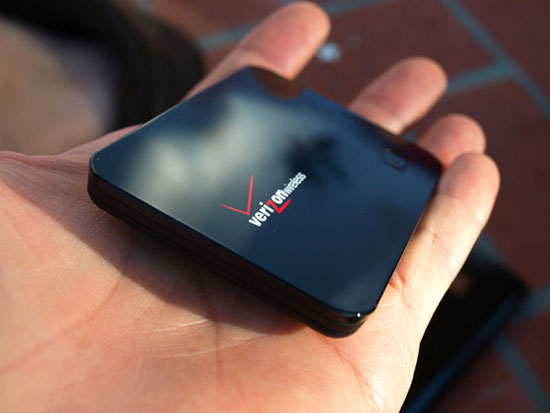
Mobile hotspots (also called personal hotspots) are the Lamborghinis, Ferraris and Porsches of broadband devices. They’re new, they’re hot, they’re slick and do a bunch of things you Honda Accord won’t do.
Personal hotspots receive mobile broadband connections from towers (like your cell phone) & broadcast it via WiFi like a wireless router.
In doing so, suddenly you no longer worry about compatibility and support for netbooks, laptops, Linux, windows or Mac. Instead, you’re figuring out how you can connect your WiFi enabled phone, printer, iTouch, camera and even digital photo frames. To stack the cool even more, you might just have GPS thrown in for good measure.

The Best USB Broadband Card of Each Carrier
If we take all of the above into consideration here’s my personal picks for the best USB broadband card from each provider:
 AT&T’s best USB broadband card is the USBConnect Velocity by Option:
- A 32 GB capacity microSD slot,
- Built-in GPS capable of voice guided turn-by-turn navigation (a first for AT&T)
- An external antenna port for improved reception in fringe areas
- Capable of 7.2 Mbps downloads and 2.0 Mbps (AT&T plans on upgrading to this speed before the end of 2010).
It’s only drawback is the lack of a swivel USB port.
If you work in cramped spaces, or throw your laptop around like me, a broadband card that points out horizontally becomes like a warrior’s spear. It’s just waiting for a chance to perform open heart surgery on your laptop’s USB ports.
In that case, a good runner up that does pack a swivel USB port would be the LG USBConnect Turbo.
The Option USBConnect Velocity is free on the spot. For more detailed info, take a look at the USBConnect Velocity review.

Sprint’s best USB broadband card is the U301 3G/4G Modem:
- Sprint 3G EVDO Rev. A speeds up to 3.1 Mbps
- Sprint 4G WiMAX speeds up to 10 Mbps
- Integrated GPS supporting Sprint Navigation, Blackberry Maps, Google Earth when using 3G.
- Support for Windows® Vista, Windows® XP, Windows® 7 (compatible mode with SSV 2.28) MAC OS® 10.5 and 10.6 (Snow Leopard)
What really takes the cake naturally is its seamless hand-off between 3G & 4G coverage areas. To its benefit, it also has a swivel USB port allowing it to point upwards for better reception and less potential mishaps.
In future models, I’d like to see an external antenna jack for fringe 3G coverage areas alongside a microSD slot.
Let’s face it, 4G speeds are awesome but if we’ve still got spots without 3G coverage, 4G probably isn’t reaching soon either. Keeping that in mind, it’d benefit a lot of users to have the option of hooking up an antenna signal booster.
The Sprint U301 is free on the spot (aff link). For more info, check out the full Sprint U301 review.

Unsurprisingly, T-Mobile’s best USB broadband card is the webConnect Rocket:
- 1st T-Mobile HSPA+ modem (up to 21 Mbps theoretical download speeds)
- microSD™ memory slot up to 16 GB
- Compatible with Windows 7, Vista & XP along with Mac OS X or higher
- External Antenna Port
T-Mobile has made a serious splash in the mobile broadband pond with the webConnect Rocket.
With real-world tested speeds of up to 11 Mbps in Philadelphia, that’s faster than what most people get with wired cable internet.
Naturally, HSPA+ isn’t available nationwide just yet. However, T-Mobile does plan to ‘flip the switch’ for east & west coast cities quite soon. When that happens, the 3G webConnect Rocket could give 4G devices a run for their money.
An unspoken drawback of the Rocket is the 5 GB cap on 3G use. Since this card can get such wicked speeds, it has the strong potential to hit the cap much quicker.
Here’s a tip T-Mobile: Don’t give me a Lamborghini Gallardo then tell me the speed limit is 50 MPH. That’s like chinese water torture.
The Rocket is available from T-Mobile. For more details, see the full T-Mobile webConnect Rocket review.
 By process of elimination, the USB760 is Verizon’s best broadband card:
- MicroSD Memory (up to 8GB)
- External Antenna Jack
- Supports Windows 2000, XP, Vista and Mac OS X 10.4(Tiger) or 10.5(Leopard) or Linux
- Really small
- Verizon 3G EVDO Rev. A speeds up to 3.1 Mbps
While there’s nothing particularly special about the USB760, all other Verizon USB broadband cards either look like Darth Vader’s helmet or a Tetris block. While I understand they go for a more business crowd, that doesn’t mean the cards need to be ugly. Last time I checked curves were sexy.
Nevertheless, if you must go USB, then this is your only viable option.
While it doesn’t have a swivel USB port, all other Verizon cards are geared towards international roaming and have no microSD slot.
The USB760 is free on the spot. For more details, check out the full Verizon USB760 review.
Best ExpressCard / PCMCIA (PC Card)

 The Sierra Wireless AirCard 402 is the best ExpressCard on the market. Half of the reason has to do with the fact that it’s a PC Card as well:
- Convenience of 2-in-1 either as PCMCIA Type II or ExpressCard
- GPS Receiver Enabled
- Easy installation – no CD required for Windows and Mac OS support
- Works with Linux
- Sprint SmartViewSM software on the device
- External antenna port
- Peak download speed of 3.1 Megabits per second
- Peak Upload speed of 1.8 Megabits per second
Like all ExpressCards & PC Cards, the AirCard 402 fits very snugly in your laptop to shield the majority of the card. Since it ships with a PC Card Adapter, it’ll also work with older laptops (or desktops).
Since it also has a external antenna port, you’ll be able to boost the signal via a mobile broadband antenna as well.
While there is no microSD slot (ExpressCards don’t usually have any), GPS is enabled for use with Sprint’s location based software, Google Earth, Bing and other applications. Unlike the AT&T USBConnect Velocity, there is no mention of turn-by-turn navigation.
The AirCard 402 is available for free (aff link). For more details, see the full Sierra Wireless AirCard 402 review.
The Best Mobile Hotspot


The Sprint Overdrive 3G/4G Mobile Hotspot is a shoo-in. It can do everything the 3G/4G USB broadband cards can do and more:
- Sprint 3G EVDO Rev. A speeds up to 3.1 Mbps
- Sprint 4G WiMAX speeds up to 10 Mbps
- Integrated GPS
- 128 × 228 pixels, 1.4" monochrome LCD
- micro-USB port (charging and tethering)
- microSD card slot (up to 16 GB)
- 1830 mAh battery (3 hour battery life / 36 hours standby)
- WiFi range up to 150 feet
- WiFi security options include: WEP, WPA Personal (TKIP/AES), WPA2 Personal (AES & AES/TKIP available)
The Sprint / Sierra Overdrive Mobile Hotspot offers up unlimited mobile broadband in 4G coverage areas for $60/month. When the faster 4G network isn’t available, you’ll have the standard 5 GB of data in 3G areas.
Naturally, the Overdrive’s biggest feature is its ability to broadcast 3G/4G connections (up to 150 feet). Since it’s a real WiFi connection and not an adhoc network, any WiFi-enabled device can connect to its password-protected network.

At just a bit longer than a AA Energizer battery on each side, it’s small enough to fit in your hand, pocket or laptop carrying case.
Nab the Sierra Overdrive for $40 (aff link) or for more details, check out the full Sierra Overdrive 3G/4G Mobile Hotspot review.
And The Best Broadband Device Award Goes To…


The Sierra Overdrive 3G/4G Mobile Hotspot. It combines the best of all worlds:
- Connect to 3G or 4G speeds via WiFi or USB
- Smaller than an iPhone
- Built-in GPS
- 16 GB capacity microSD slot that can be shared via WiFi
- Unlimited mobile broadband when on the 4G WiMAX network
Does this make it perfect?
Not quite. It would be nice to see an external antenna port and a longer battery life. Add these 2 features in and this thing would be unstoppable. Nevertheless, it’s still the best offer available for most people even without these minor inconveniences.
Nab the Sierra Overdrive for $40 (aff link).
Don’t Want a Mobile Hotspot?
Then your next best bet is a USB broadband card. Which of the best USB cards you get will depend on what you personally need in a device:
![verizon-usb760[5]](wp-content/uploads/2010/12/verizon-usb7605.jpg "verizon-usb760[5]") The Verizon USB760 is excellent if you need great coverage or live in a fringe coverage area.
The Verizon USB760 is excellent if you need great coverage or live in a fringe coverage area.
Not only does Verizon have great 3G coverage, it also has an external antenna jack to get an even better signal. The USB760 is free on the spot (aff link).
 If you like feature rich devices, then the AT&T USBConnect Velocity will be your baby. With a 32 GB capacity microSD slot, it’ll even store full length Blu-Ray movies if you want.
On top of that, you’ve optional voice guided GPS, an external antenna port (though AT&T doesn’t have the best 3G coverage) and a bit of future proofing with 7.2 Mbps theoretical download speeds later this year. For pricing, check AT&T.
 If you’ve got a serious need for speed, you’ll wanna pick up either the Sprint U301 or T-Mobile webConnect Rocket.
The Sprint U301 can get up to 10 Mbps on Sprint’s 4G network while real world tests have shown the  webConnect Rocket getting up to 11 Mbps on T-Mobile’s HSPA+ network.
Which of the two you get boils down to what’s available in your area.
If you’ve got 4G coverage, go for the Sprint U301. On the other hand, if you’ve got HSPA+ coverage, go for the webConnect Rocket.
The Sprint U301 is free on the spot and you can check T-Mobile for pricing on the webConnect Rocket.
Still Not Sure?
If you’ve got an idea of the device you’d like but are thinking of whether or not the network its on will be up to par, then check out the 2010 Wireless Broadband Comparison. The nation’s top 5 carrier’s duke it out for the top gun title of mobile broadband king.
Related Reviews:
2010 Wireless Broadband Comparison
2010 Prepaid Mobile Broadband Comparison
2010 Mobile Broadband Rental Comparison
deborah says:
Thanks to your email yesterday and my investigating everything here, I finally clicked on the link to the Sprint HotSpot deal and it will arrive this Wednesday!! After being on dialup since ’96, I can’t tell you how excited I am to finally be able to have a broadband connection! Dialup now is just about useless since the internet has come so far. I was seriously ready to store my laptop in the closet and now I don’t have to! Thank you for all the hard work you do for we newbies to mobile broadband. Being out in the country we have few really fast options.
I have plastered your website all over my FB page! ;-)
Marc says:
Thank you kindly Deborah. I greatly appreciate it :-)
affiliate networks says:
Thanks in support of sharing such a good thinking, post is
nice, thats why i have read it completely