
What is Long Term Evolution?
Services like home phones, cell phones, television, and the internet were once separate. We are now approaching a supercharged tipping point:
-
Cell phones that were analog became digital
-
Home phones are becoming increasingly digital through Voice over Internet Protocol (VoIP)
-
Television is rapidly moving to fully digital programming with the rise of HD broadcasts
With these services becoming digital, it became possible for internet service providers (ISPs) like Comcast and Time Warner to compete with traditional phone companies. Cellular companies like T-Mobile have already begun to supplement their regular service with mobile VoIP. Long Term Evolution will blow the gasket off the convergence engine.
How will that happen?
Long Term Evolution (LTE) is a wireless broadband 4G technology. With a maximum theoretical download speed of 326 Mbps, it’s built for mobility and capacity.
Because its a high capacity wireless broadband network, the fixed line restrictions are gone. HDTV, voice communication and the internet will now come to you wherever you are. Imagine plugging your iPhone into a TV to stream HD content from iTunes. That’s what were talking about here.
How Fast is LTE?
"Users desire services like voice, music, broadband internet, picture and video sharing, live video sharing and social networking, anytime and anywhere, with a similar experience regardless of location. Mobile broadband is in the center of convergence"
– Qualcomm, 3G and 4G equipment developer
If we’re going to get pretty much everything, everywhere, we’ll need some really big internet pipes.
Enter LTE.
Field tests have shown download speeds of 277 Mbps and upload speeds of 75 Mbps. HDTV streaming is possible with as low as 30 Mbps. With that kind of speed, all services digital services we currently use can be funneled through one pipe. Imagine having a flat cell phone bill because it’s all VoIP.
Think of what a flat $30 or $40 bill for unlimited mobile calling would be like. It’s happened for fixed lines. Mobile lines are next.
On top of that, it’s a mobile connection that can replace current fixed ones with better results. Here’s what a comparison of current and emerging technologies looks like against LTE:
|
Connection Type |
Average Download Speed |
Maximum Download Speed |
Average Upload Speed |
Maximum Upload Speed |
|
Dialup |
40-50 kbps |
1 Mbps* |
N/A |
N/A |
|
3G (EVDO/HSPA) |
600 – 1400 kbps |
3.1 Mbps |
500 – 800 kbps |
1.8 Mbps |
|
DSL |
2.971 Mbps |
10 Mbps |
512 kbps |
896 kbps |
|
Cable |
2 – 4.8 Mbps |
16 Mbps |
3 Mbps |
1 Mbps |
|
WiFi Hotspots |
1 – 3 Mbps |
20 Mbps |
N/A |
N/A |
|
WiMAX |
6 – 15 Mbps |
70 Mbps |
3 Mbps |
70 Mbps |
|
LTE |
16 – 25 Mbps*** |
277 Mbps** |
3 Mbps*** |
75 Mbps** |
*1 Mbps dialup speed achieved by compression by Internet Service Provider servers.
**Highest field test results for LTE.
***10 MHz deployment
To see how your current speed matches up, use this speed test tool below:
Who provides it?
Verizon.
LTE launched on Verizon’s network in December 2010 in multiple markets across the United States. Expect mass adoption in 2012.


AT&T, admittedly slower than Verizon is also in the process of making LTE their next generation network infrastructure. It would only make sense for roaming partnerships to appear.
T-Mobile has not committed just yet as it tests both LTE and WiMAX 4G technologies. In the meantime, they advertise having a 4G network although it’s really really fast 3G that can actually compete with existing 4G speeds.
Competing Technologies?
The biggest competitor to LTE in the United States right now is WiMAX with Ultra Mobile Broadband (UMB) falling a distant second. UMB has the potential to be a stark contender, however, without any adopting carriers, it’s on the back burner.
There are 3 major reason why WiMAX can hold its own in a LTE vs. WiMAX boxing match:
Speed
While LTE has a higher download speed, the real benchmark is what people will experience day to day. Depending on how much money investors throw at it, WiMAX and LTE have similar average download speeds and upload speeds.
Money
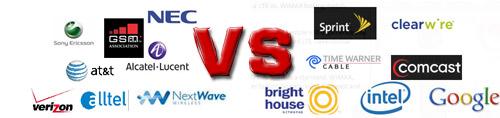
LTE has 2 major carriers already backing it as a standard. WiMAX, however, also has some serious financial backing. Between Sprint, Google, Intel, Comcast and Time Warner (just to name a few), that’s a lot of cash.
Timing
Long Term Evolution launched in December 2010 many months after Sprint launched it’s 4G WiMAX network.
Where to get it?
Verizon for now and AT&T later providing you’re in the right market.
When more information does become available (i.e. pricing, retailers), it’ll be posted here. Subscribe to the RSS feed just under the navigation bar to the left to get the word when it happens.
Related Reading:
Sprint WiMAX – 5 Things You Should Know
Wireless Broadband Service Comparison
anthony aloh says:
interesting, we are also implementing LTE in our next phase of telco-infra works.
chloe sims sodium lauryl sulfate free dandruff shampoo says:
As you move closer to compliment her on her tan, you notice that it is smeared in several places and is more of a festive
orange than a sexy bronze. Drinking hot beverages and contact with
toothpaste can strip the color of your tan from areas around your mouth, so be careful.
Many of us I dare say have been put off by fake tans as we struggle to apply it correctly.
facial Plastic Surgeon Brisbane says:
This is considered to be the main risk with rhinoplasty and
it accounts for 5-15% of the cases that cause revision surgery as based on studies.
However, apart from beauty purposes, nose jobs are also used to correct problems
that might have occurred due to a misshapen nose, such as breathing.
Provided the Big Three can stay relatively healthy, the Heat
have the potential to be unstoppable.