
- What is Mobile Broadband?
- Types of Mobile Broadband?
i. EV-DO
ii. HSPA
iii. WiMAX
iv. LTE - The Future of Mobile Broadband
- Mobile Broadband Devices
- Mobile Broadband Providers
Mobile Broadband is any technology that allows someone to access the internet at broadband speeds while on the go. Depending on where you go it might be described as wireless broadband. However, there’s a big difference here.
A simple way to understand it would be to think of wireless broadband (WiFi for example) like a cordless phone. It’s good for around the house. Mobile broadband, however is like your cell phone. Good just about any and everywhere.
So, if mobile broadband is like your cell phone, then there must be multiple providers (read: different kinds of mobile broadband) right?
You bet there are.
Right now, (in the United States), there are 2 main ways to get mobile broadband:
1. Evolution Data Optimized (EV-DO)
2. High Speed Packet Access (HSPA)
EV-DO is based on CDMA technology (think regular old cell phones). The major carriers that provide mobile broadband through EV-DO networks right now are Sprint, Verizon and Alltel. It now reaches up to 3.1 Mbps while downloading and 1.8 Mbps uploading.
If you’re wondering how fast 3.1 Mbps or 1.8 Mbps is, use this tool to see how fast what you’ve got right now is to get an idea.
EV-DO is more or less in its prime right now and is rapidly decreasing in popularity.
As a matter of fact, Verizon and Alltel are abandoning future development of EV-DO networks in favor of Long Term Evolution (LTE). For more details like the different speed classes of EV-DO, check out EV-DO – 5 Things To Know.
High Speed Packet Access comes from the GSM family. The major carriers that have GSM networks are AT&T and T-Mobile. HSPA has a theoretical download max of 14.4 Mbps but 7.2 Mbps is the current maximum available right now.
Despite the technology being able to support these speeds, AT&T‘s network speed caps out at 1.7 Mbps down and 1.2 Mbps up. These numbers are going up as they prep for 3G iPhone data traffic.
T-Mobile‘s 3G network is still as fresh as morning dew. As soon as benchmarks for their speeds are available, we’ll have them here.
There are 2 emerging technologies that are looking to replace EV-DO and HSPA as the standard mobile broadband technology:
1. WiMAX
2. Long Term Evolution (LTE)
WiMAX is neither an evolution of CDMA or GSM technology. If anything it’s more related to WiFi but on steroids. It surpasses the speeds of Cable and DSL connections while spanning entire regions with cell phone-like coverage. For details like on things like how Sprint is trying to use it to stage a comeback beginning in September, read Sprint WiMAX – 5 Things You Should Know.
LTE seeks to do the same thing as WiMAX but with a different technology. Its speeds make cable internet look obsolete. It has a maximum theoretical download speed of 326 Mbps.
You could download a 30 minute High Definition TV show in one second at that speed.
It has the potential do to broadband what cell phones did to home phones. More people have cell phones that home phones. Unlike WiMAX or EVDO, LTE is based on GSM technology and is shaping up to be a world standard. For full details like its 2010 launch, see Long Term Evolution: 5 Things Everyone Should Know.
You’ve got two options (well, 2 and a half if you count tethering):
1. Cell Phones
2. Mobile Broadband Cards
3. Portable Satellite Modems
Cell Phones
At first, this might have been “PDAs and Smartphones” but most new phones connect to 3G networks for content like songs, video clips or ringtones. If you’re taking this route, then you need no additional equipment. You may even decide to ‘tether’ your phone to your laptop to connect on the go. The downside to this is some carriers throw an extra fee on for this and it may not run as fast as a dedicated data aircard.
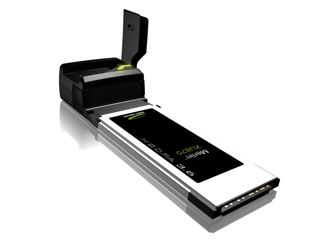
Mobile broadband cards are little devices you can plug into your laptop (which part depends on the type of broadband card). One benefit is that it works like a mobile DSL connection for about $60 a month. Cheaper plans are available with some carriers but it’s not usually worth the time of day due to really low usage caps (40-50 MB/month = less than a music album).
Portable Satellite Modems
In addition to getting mobile broadband through the cell phone companies, you can also get it from Satellite providers. While this site focuses on cell providers for mobile broadband, they don’t have coverage everywhere. For places where it’s unavailable, portable satellite modems may just be the solution.
To get the service, you’re either going to need to get a cell phone or aircard through one of the major mobile broadband providers. If you plan to use it as a dedicated internet connection on the go, I recommend the aircard option. There are just some things that you need laptop for that a phone won’t handle.
For manicured details most people wish they had, sign up for the Free Mobile Broadband Buyer’s Guide E-Course.
Consider it 4 lessons with the laser light focus of protecting your consumer rights and checkbook.
Oh by the way…
Hop over to our partner if you’d like a free aircard that could put $100 in your pocket. Just a freebie tip from me to you. Naturally, it’ll support the site too.
Related Reading:
 2010 Broadband Card Comparison
The Top 4 Places to Get An Aircard
Sprint WiMAX – 5 Things You Should Know
Long Term Evolution: 5 Things Everyone Should Know

Home | Mobile Broadband | EV-DO | WiMAX | LTE |
| Wireless Broadband Service Comparison |